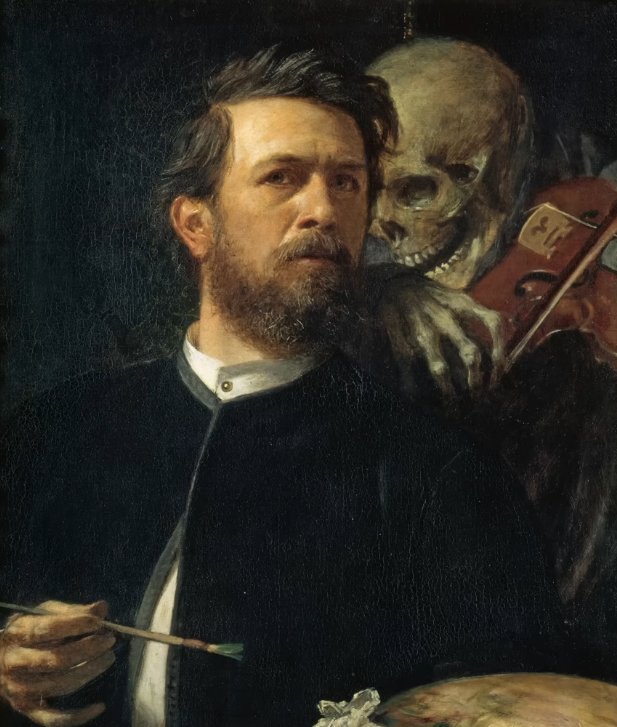
Image Source: Death Playing the Fiddle by Arnold Böcklin
Enact
1.27.2026
Let's talk about my favorite topic, death, death is something we will all face one day either when you're old or young, death is inevitable in the long run.
Even though other philosophers have written about death, I believe that it is a topic that deserves more attention and discussion.
Death is the end of an organism's life, death is the irreversible cessation of all biological functions that sustain a living organism.
There are many different beliefs and theories about what happens after death, but ultimately, we may never know for certain.
Some people believe in an afterlife, while others believe in reincarnation or simply that death is the end of consciousness.
Both the longest to live and the earliest to die are subject to the same fate; death.
It is only the present moment of which either stands to be deprived.
Death is a natural part of life, and it is something that we must all come to terms with.
Every phenomenon that arises is bound by time, and thus, must eventually cease — this principle holds true even for the universe.
However, the inevitability of death can also serve as a reminder to live life to the fullest and to appreciate the time we have.
It is not death that a man should fear, but he should fear never beginning to live. — Marcus Aurelius
Terror Management Theory (TMT) is a social psychology theory that explores how humans cope with the awareness of their own mortality.
According to TMT, the knowledge of our own mortality creates a sense of existential anxiety, which can lead to a range of psychological and behavioral responses.
One of the key tenets of TMT is that humans have developed cultural worldviews and belief systems that provide a sense of meaning and purpose in life.
These worldviews often include beliefs about the afterlife, the nature of existence, and the value of human life.
When individuals are reminded of their own mortality, they may become more defensive of their cultural worldviews and more motivated to uphold them.
This can lead to increased nationalism, religious fervor, and other forms of group identity.
TMT has been used to explain a range of phenomena, including prejudice, aggression, and political behavior.
Overall, TMT highlights the powerful influence that the awareness of mortality can have on human behavior and psychology.
It suggests that our cultural beliefs and worldviews play a crucial role in helping us manage the anxiety that arises from our awareness of death.
In conclusion, death is a complex and multifaceted topic that has been explored by philosophers, scientists, and theologians throughout history.
While death is often viewed as a negative or frightening experience, it is also a natural part of life that can serve as a reminder to live fully and appreciate the time we have.
By understanding the psychological and cultural responses to death, we can gain a deeper appreciation for the human experience and the ways in which we cope with our mortality.
This is the terror: to have emerged from nothing, to have a name, consciousness of self, deep inner feelings, and excruciating inner yearning for life and self expression — and with all this yet to die. — Ernest Becker
Most Information gathered from: Wikipedia
© 2026 blog.stepd.ad